🛈 If you buy through our links, Amazon pays us a small commission at no extra cost to you. That is how we fund these guides. How we choose.
📑 Table of contents
Buy a dehumidifier that is too small and you waste your money: it runs nonstop and the room stays damp. Buy one that is far too big and it takes up space and costs more than it should. Use the calculator below to find out in 10 seconds how many pints per day you need and which type fits your space, based on square footage and how damp it is.
Calculator: what size dehumidifier do I need?
Estimate based on common sizing guidelines and current (2019 DOE) pint ratings. Living near the coast, in the humid Southeast, or drying laundry indoors may call for more capacity.
Dehumidifier sizing chart
Prefer a chart? These are the sizes the calculator uses, in pints per day under current ratings:
| Area | Moderately damp | Very damp | Wet | Extremely wet |
|---|---|---|---|---|
| Closet, half bath, up to 150 sq ft | Mini unit | Compact unit | 22 pints | 22 pints |
| 150–500 sq ft (bedroom) | 22 pints | 22 pints | 22 pints | 22–35 pints |
| 500–1,000 sq ft | 22 pints | 22–35 pints | 35 pints | 35–50 pints |
| 1,000–1,500 sq ft | 35 pints | 35–50 pints | 50 pints | 50 pints |
| 1,500–2,500 sq ft | 35–50 pints | 50 pints | 50+ pints | Two units |
Not sure how damp your space is? A cheap hygrometer tells you in minutes. Normal values are explained in our guide to ideal indoor humidity.
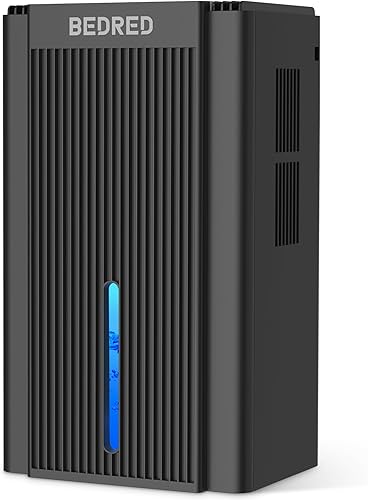
One pick for each size



How sizing works (and why you need margin)
Pint ratings come from a standardized test at 65 °F and 60% relative humidity. Your basement in April or your bedroom in January may be cooler or drier, so the unit removes less. That is why sizing guides always build in margin:
- Start with the square footage of the space you want to dry, with doors closed.
- Factor in dampness: the wetter it is, the more pints per square foot.
- Round up to the next common size: 22, 35 or 50 pints.
- Go one size up if you dry laundry indoors, live in a humid coastal area or the space is a basement with poor drainage.
A unit with some headroom hits the target (45–50%) sooner and then rests thanks to the humidistat, so it does not cost more just because it is bigger. Worried about the bill? See how much electricity a dehumidifier uses.
Old vs. new pint ratings
In 2019 the Department of Energy changed the test temperature from 80 °F to 65 °F. Ratings dropped even though the machines did not change. If you are reading an old review or replacing an old unit, convert like this:
| Old rating (before 2019) | Current rating (approx.) |
|---|---|
| 30 pints | 20–22 pints |
| 50 pints | 35 pints |
| 70 pints | 50 pints |
Real-world examples
12 × 14 ft bedroom with wet windows
About 170 sq ft and very damp: a 22-pint unit or a large compact unit with a sleep mode. Run it in the evening and air out in the morning. Options in the best dehumidifier for a bedroom.
900 sq ft finished basement, musty smell
Very damp: 35 pints, ideally with a drain hose.
1,400 sq ft unfinished basement with damp walls
Wet: 50 pints with continuous drainage to a floor drain or sump. More in our basement dehumidifier guide.
Walk-in closet
A mini thermoelectric or cordless rechargeable unit. See closet dehumidifiers.
Adjust for where you live
The same 1,000 sq ft basement behaves very differently in Houston and in Denver. In the humid Southeast, the Gulf Coast and much of the Midwest and Northeast, summer dew points stay high for months and basements soak up moisture day and night: size toward the upper end of the range. In the dry Mountain West and the desert Southwest, many homes never need more than a small unit for a bathroom or closet. Coastal homes in the Pacific Northwest deal with long damp, cool winters, where a unit that keeps working at lower temperatures matters more than raw capacity.
Once you know the size: features that matter
- Drain hose connection: essential for any unit that will run in a basement for months.
- Built-in pump: only needed if the water has to go up to a sink or out a window.
- Auto-restart after a power outage: keeps your settings so the basement does not sit damp for days after a storm.
- Auto-defrost: a must for spaces that drop below 60 °F (15 °C).
- Energy Star: more water per kWh. See what a dehumidifier costs to run.
- Washable filter and handles or wheels: small details that make a 40 lb machine easier to live with.
Now you know your size
Compare the top-rated dehumidifiers by capacity, noise and running cost and pick yours.
See the full comparison →Frequently asked questions
What size dehumidifier do I need for 1,000 sq ft?
Under the current DOE ratings, a 35-pint unit handles 1,000 sq ft that is moderately damp. If the space is very damp or wet, such as a basement with damp walls, go for a 50-pint unit.
What size dehumidifier for a 2,000 sq ft basement?
A 50-pint unit is the starting point. If the basement is wet or has seepage, use a larger-capacity model or two units in different zones, and connect them to a drain so they can run continuously.
What does "pints per day" mean?
It is the maximum water the unit can remove in 24 hours under standard test conditions: 65 °F (18 °C) and 60% humidity since 2019. In a cooler or drier space it removes less, which is why it pays to size with some margin.
Is a bigger dehumidifier better?
Within reason, yes. A larger unit reaches your target humidity faster and then cycles off, so it does not necessarily cost more to run. The downsides are size, weight and price. An undersized unit runs nonstop and never gets the space dry.
Is a 50-pint dehumidifier the same as an old 70-pint?
Roughly, yes. Under the old test at 80 °F (27 °C), the same machines were rated higher. As a rule of thumb, today’s 50-pint is about yesterday’s 70-pint, today’s 35-pint about the old 50-pint and today’s 22-pint about the old 30-pint.
📚 Sources and references
Official agencies for more information on humidity, mold and indoor air quality.
- A Brief Guide to Mold, Moisture, and Your Home — U.S. Environmental Protection Agency (EPA)
- Mold — U.S. Environmental Protection Agency (EPA)
- WHO guidelines for indoor air quality: dampness and mould — World Health Organization (WHO)
- Dehumidifiers — ENERGY STAR