🛈 If you buy through our links, Amazon pays us a small commission at no extra cost to you. That is how we fund these guides. How we choose.
📑 Table of contents
You do not need to spend a fortune to fix a damp room. But "cheap" can also mean money thrown away on a gadget that fills a thimble of water a day while your walls keep sweating. These are the budget dehumidifiers and moisture absorbers that actually pull water out of the air, and exactly where each one makes sense.
⚡ Quick summary: our top picks
Stock checkedThe best cheap dehumidifiers
Ranked by value: how much moisture you get for your money. Price tiers are shown on each card and update with Amazon.com.
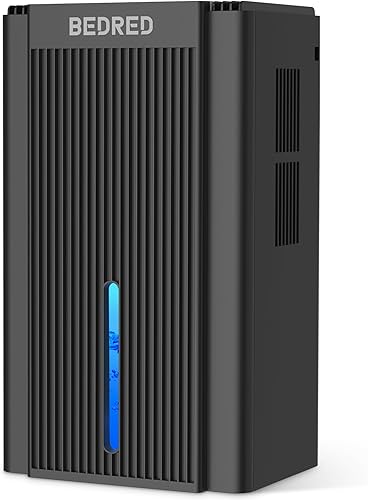
BEDRED 95 oz Dehumidifier for Home
Best for bedrooms and bathrooms
- 95 oz tank
- Auto shut-off
- Sleep mode
- Compact size
Our verdict, pros and cons
A compact best seller with a 95 oz tank, auto shut-off and a quiet sleep mode.
- + Quiet
- + Affordable
- – Not for basements

50-Pint Basement Dehumidifier with Drain Hose and 1.7 gal Tank
Best for damp basements on a budget
- 50 pints/day
- 1.7 gal tank
- Drain hose
- Up to 4,500 sq ft
Our verdict, pros and cons
A popular 50-pint unit with a 1.7-gallon tank and a drain hose for basements up to 4,500 sq ft.
- + Large tank
- + Good value
- – Generic brand

DampRid Fragrance Free Hanging Moisture Absorber (3 pack)
Best for closets: the best seller
- 3 hanging bags
- Fragrance free
- No electricity
Our verdict, pros and cons
America's best-known moisture absorber: hang it in the closet and it traps water in the bottom pouch.
- + Very effective in closets
- + Zero maintenance
- – Disposable

ToLife Dehumidifier with 95 oz Tank and Sleep Mode
Best for small apartments
- 95 oz tank
- Sleep mode
- Auto shut-off
Our verdict, pros and cons
Compact dehumidifier with a 95 oz tank, sleep mode and auto shut-off.
- + Easy to use
- + Quiet at night
- – Limited capacity

SANVINDER 25 oz Mini Dehumidifier
Best for closets and small bedrooms
- 25 oz tank
- Ultra quiet
- Auto-off when full
Our verdict, pros and cons
A tiny, ultra-quiet thermoelectric dehumidifier for closets, RVs and small bedrooms.
- + Very quiet
- + Low energy use
- – Small capacity
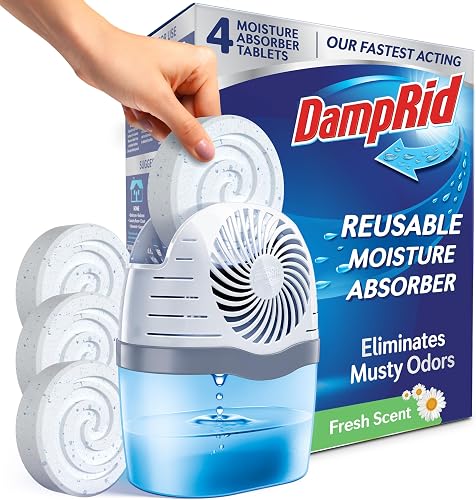
DampRid Refillable Moisture Absorber with 4 Tablets
Best for bathrooms and laundry rooms
- 4 drop-in tablets
- Refillable
- No electricity
Our verdict, pros and cons
A refillable tub with drop-in tablets that trap moisture and odors.
- + Cheap refills
- – Needs emptying

Eva-Dry E-333 Renewable Wireless Mini Dehumidifier
Best for closets, safes and cabinets
- No cord while in use
- Color indicator
- Recharges overnight
- Lasts years
Our verdict, pros and cons
A cordless silica-gel dehumidifier: when the indicator turns pink, plug it in overnight to recharge. A classic with tens of thousands of reviews.
- + Reusable
- + Silent
- – Small capacity
Quick comparison
| Product | Type | Capacity | Tank | Score | Buy |
|---|---|---|---|---|---|
| ⭐ Our top pick BEDRED 95 oz | Compact | — | 95 oz | 8.4 | Check price |
| 50 Pint with drain hose | Compressor | 50 pints/day | 1.7 gal | 8.4 | Check price |
| DampRid Hanging (3) | Hanging bag | — | — | 9.0 | Check price |
| ToLife 95 oz | Compact | — | 95 oz | 8.3 | Check price |
| SANVINDER mini | Mini (Peltier) | — | 25 oz | 8.3 | Check price |
| DampRid Refillable | Refillable tub | — | — | 8.6 | Check price |
| Eva-Dry E-333 | Renewable silica | — | — | 8.6 | Check price |
What a cheap dehumidifier can and cannot do
| Budget option | Works well in | Do not expect it to |
|---|---|---|
| Hanging absorber bags | Closets, cabinets, small storage areas | Dry a whole room |
| Refillable absorber tubs | Bathrooms, laundry rooms, RVs in storage | Handle a basement |
| Mini thermoelectric | Closets, half baths, small bedrooms | Fix wet windows in a big room |
| Compact unit with large tank | Bedrooms, small apartments | Keep up with a damp basement |
| Value 50-pint compressor | Basements, whole floors | Be whisper quiet |
How to buy cheap without buying twice
- Measure the space and the humidity. A $10–15 hygrometer is the best money you will spend: it tells you if you need a mini unit or a real machine.
- Size it honestly. Use our sizing calculator. Undersizing is the most expensive mistake.
- Count the running costs. Disposable absorbers look cheap, but replacing them every month for years adds up. A rechargeable unit or an electric one often wins long term.
- Check auto shut-off. Even the cheapest electric unit should stop when full.
- Look for a drain hose option if it will run in a basement: emptying a bucket twice a day gets old fast.
Cheap to buy, cheap to run?
A mini thermoelectric unit draws about 25–50 W, around $3 a month even running 24/7 at typical US rates. A 50-pint unit draws much more, around $18–29 a month at 8 hours a day, but it removes dozens of times more water. Details and a calculator in how much electricity a dehumidifier uses.
Free fixes that stretch any budget
- Run the bathroom fan 20 minutes after every shower.
- Use the range hood when you boil water or cook.
- Air out bedrooms for 10 minutes each morning.
- Keep gutters clean and downspouts pointing away from the foundation.
Want to compare more powerful options too? See our main guide to the best dehumidifiers of 2026 or our ranking of moisture absorbers.
Frequently asked questions
Are cheap dehumidifiers any good?
Cheap compact and mini units work well for what they are: closets, small bathrooms, RVs and small bedrooms. Where buyers get disappointed is expecting a small budget unit to dry a basement. For that you need a 35–50 pint compressor model, which costs more.
What is the cheapest way to dehumidify a room?
Free habits first: open windows on dry days, run bathroom and kitchen fans, do not air-dry laundry indoors. Next, hanging moisture absorbers cost a few dollars each. For ongoing dampness, an electric dehumidifier ends up cheaper than buying absorbers forever.
Do mini dehumidifiers actually work?
Yes, in small enclosed spaces. A thermoelectric mini pulls a few ounces of water a day, which is plenty for a closet or a small bathroom, but far too little for an open room or a basement.
Which is cheaper to run, a small or a big dehumidifier?
Per hour, the small one. Per pint of water removed, the big compressor unit wins by far. If you need to dry a large space, a properly sized compressor unit is cheaper overall.
📚 Sources and references
Official agencies for more information on humidity, mold and indoor air quality.
- A Brief Guide to Mold, Moisture, and Your Home — U.S. Environmental Protection Agency (EPA)
- Mold — U.S. Environmental Protection Agency (EPA)
- WHO guidelines for indoor air quality: dampness and mould — World Health Organization (WHO)
- Dehumidifiers — ENERGY STAR