🛈 If you buy through our links, Amazon pays us a small commission at no extra cost to you. That is how we fund these guides. How we choose.
📑 Table of contents
Rust spots on your tools, a musty smell from cardboard boxes, a slick concrete floor on humid mornings: garages trap moisture because they are poorly insulated, the slab stays cool and the door lets in muggy outside air every time it opens. A garage dehumidifier protects your tools, car and stored stuff, but it has to be the right type for the temperature.
⚡ Quick summary: our top picks
Stock checkedThe best garage dehumidifiers
Ranked for garages, workshops and storage spaces, all in stock on Amazon.com.
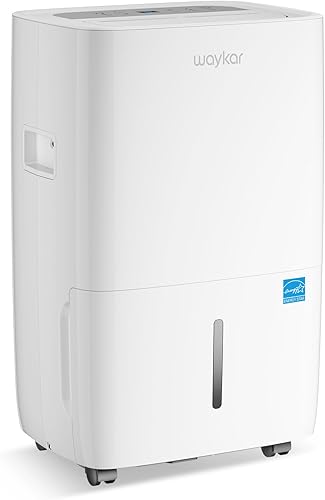
Waykar 80-Pint Energy Star Dehumidifier
Best for basements and large homes
- Up to 80 pints/day
- Covers up to 5,000 sq ft
- Energy Star certified
- Continuous drain option
Our verdict, pros and cons
One of the best-selling basement dehumidifiers on Amazon, rated for spaces up to 5,000 sq ft and Energy Star certified.
- + Huge capacity
- + Thousands of positive reviews
- – Bulky for small rooms

50-Pint Basement Dehumidifier with Drain Hose and 1.7 gal Tank
Best for damp basements on a budget
- 50 pints/day
- 1.7 gal tank
- Drain hose
- Up to 4,500 sq ft
Our verdict, pros and cons
A popular 50-pint unit with a 1.7-gallon tank and a drain hose for basements up to 4,500 sq ft.
- + Large tank
- + Good value
- – Generic brand

AEOCKY 50-Pint Ultra-Quiet Dehumidifier with Drain Hose
Best for quiet whole-floor drying
- 50 pints/day
- Up to 3,500 sq ft
- Drain hose included
- Around 40 dB
Our verdict, pros and cons
A 50-pint compressor model rated around 40 dB, with a drain hose for continuous operation.
- + Quiet for its capacity
- + Hands-free draining
- – Less known brand

Eva-Dry E-333 Renewable Wireless Mini Dehumidifier
Best for closets, safes and cabinets
- No cord while in use
- Color indicator
- Recharges overnight
- Lasts years
Our verdict, pros and cons
A cordless silica-gel dehumidifier: when the indicator turns pink, plug it in overnight to recharge. A classic with tens of thousands of reviews.
- + Reusable
- + Silent
- – Small capacity

DampRid Fragrance Free Hanging Moisture Absorber (6 pack)
Best for whole-house value pack
- 6 hanging bags
- Fragrance free
Our verdict, pros and cons
The same DampRid bags in a 6-pack for several closets.
- + Better value per bag
- – Disposable

Govee H5075 Bluetooth Hygrometer Thermometer
Best for tracking humidity on your phone
- Bluetooth app
- History and alerts
- Large display
Our verdict, pros and cons
A best-selling hygrometer with app history and alerts — the first thing to buy before a dehumidifier.
- + Accurate and cheap
- + Great app
- – Bluetooth range only
Quick comparison
| Product | Type | Capacity | Room size | Score | Buy |
|---|---|---|---|---|---|
| ⭐ Our top pick Waykar 80 Pint | Compressor | 80 pints/day | up to 5,000 sq ft | 8.9 | Check price |
| 50 Pint with drain hose | Compressor | 50 pints/day | — | 8.4 | Check price |
| AEOCKY 50 Pint | Compressor | 50 pints/day | up to 3,500 sq ft | 8.7 | Check price |
| Eva-Dry E-333 | Renewable silica | — | — | 8.6 | Check price |
| DampRid Hanging (6) | Hanging bag | — | — | 8.8 | Check price |
| Govee H5075 | Bluetooth | — | — | 9.1 | Check price |
What size for your garage?
| Garage | Approx. size | Recommended |
|---|---|---|
| One-car | 200–300 sq ft | 35 pints (or 22 pints if only slightly damp) |
| Two-car | 400–600 sq ft | 35–50 pints |
| Three-car or workshop | 600–900 sq ft | 50 pints with drain hose |
| Detached, no outlet | Any | Moisture absorbers and silica in key spots |
Use our sizing calculator for a precise number.
Temperature matters more than you think
Compressor dehumidifiers work best above 65 °F (18 °C). Between 50 and 60 °F (10–15 °C) they still work but remove noticeably less water, and close to freezing the coil can ice up. Look for auto-defrost and a low minimum operating temperature in the specs. For a garage that stays cold most of the year, a desiccant dehumidifier is the better match, though it uses more electricity.
Setup tips for a garage
- Close the space. Keep the garage door shut while it runs and weatherstrip the bottom seal.
- Raise it off the floor on a sturdy shelf or cart if the slab gets wet, and keep it level.
- Drain it. Run a hose to a floor drain or under the door to the driveway.
- Keep it away from fuel and solvents. Gas cans and paint thinner do not belong next to any electrical appliance.
- Plug into a GFCI outlet, ideally on its own circuit if you also run power tools.
Protect what matters most
- Tools: keep a rechargeable silica pack inside each tool chest drawer and wipe tools with a light oil.
- Stored clothes and papers: use sealed plastic bins with a few silica packs, never cardboard on the floor.
- The car: let it dry before closing up for the night in winter.
- Drywall: if you see mold spots, here is how to remove mold from walls.
For storage areas without power, compare the best moisture absorbers. For a damp basement, see our basement dehumidifier guide.
Frequently asked questions
Do I need a dehumidifier in my garage?
If you see rust on tools, musty boxes, condensation on the car or the floor, or mold on drywall, yes. Attached garages in humid regions like the Southeast and Gulf Coast benefit most, especially if you use them as a workshop or for storage.
Will a dehumidifier work in a cold garage?
Compressor units lose a lot of capacity below about 60 °F (15 °C) and can frost up near freezing, although most have auto-defrost. In an unheated garage in a northern winter, humidity problems usually ease anyway; run it in spring, summer and fall.
What size dehumidifier for a two-car garage?
A two-car garage is roughly 400–600 sq ft. A 35-pint unit handles mild dampness; for a humid climate or a garage with a damp slab, choose a 50-pint unit with a drain hose.
Where should the water go in a garage?
The easiest option is a hose to a floor drain or out under the garage door to the driveway. If there is no drain, choose a model with a big bucket or a built-in pump.
Is it safe to run a dehumidifier in a garage?
Yes, with common sense: plug it into a GFCI outlet, keep it away from gasoline, solvents and paint fumes, and never use an extension cord that is too light for the load.
📚 Sources and references
Official agencies for more information on humidity, mold and indoor air quality.
- A Brief Guide to Mold, Moisture, and Your Home — U.S. Environmental Protection Agency (EPA)
- Mold — U.S. Environmental Protection Agency (EPA)
- WHO guidelines for indoor air quality: dampness and mould — World Health Organization (WHO)
- Dehumidifiers — ENERGY STAR