🛈 If you buy through our links, Amazon pays us a small commission at no extra cost to you. That is how we fund these guides. How we choose.
📑 Table of contents
If your closet smells stale when you open it, your clothes feel cool and slightly damp or you spot tiny gray-green dots on leather shoes and belts, you have a moisture problem. The good news: it is cheap to fix if you pick the right product. We compared the best-selling closet dehumidifiers and moisture absorbers on Amazon.com, and these are the ones that work.
⚡ Quick summary: our top picks
Stock checkedThe best closet dehumidifiers
Ranked by effectiveness, convenience and buyer feedback. All are in stock on Amazon.com.

DampRid Fragrance Free Hanging Moisture Absorber (3 pack)
Best for closets: the best seller
- 3 hanging bags
- Fragrance free
- No electricity
Our verdict, pros and cons
America's best-known moisture absorber: hang it in the closet and it traps water in the bottom pouch.
- + Very effective in closets
- + Zero maintenance
- – Disposable

SANVINDER 25 oz Mini Dehumidifier
Best for closets and small bedrooms
- 25 oz tank
- Ultra quiet
- Auto-off when full
Our verdict, pros and cons
A tiny, ultra-quiet thermoelectric dehumidifier for closets, RVs and small bedrooms.
- + Very quiet
- + Low energy use
- – Small capacity

Eva-Dry E-333 Renewable Wireless Mini Dehumidifier
Best for closets, safes and cabinets
- No cord while in use
- Color indicator
- Recharges overnight
- Lasts years
Our verdict, pros and cons
A cordless silica-gel dehumidifier: when the indicator turns pink, plug it in overnight to recharge. A classic with tens of thousands of reviews.
- + Reusable
- + Silent
- – Small capacity

Arm & Hammer Hanging Moisture Absorber (3 pack)
Best for musty closets
- 3 hanging bags
- Odor eliminator
Our verdict, pros and cons
Hanging moisture absorber with odor elimination.
- + Trusted brand
- – Scented

DampRid Fragrance Free Hanging Moisture Absorber (6 pack)
Best for whole-house value pack
- 6 hanging bags
- Fragrance free
Our verdict, pros and cons
The same DampRid bags in a 6-pack for several closets.
- + Better value per bag
- – Disposable
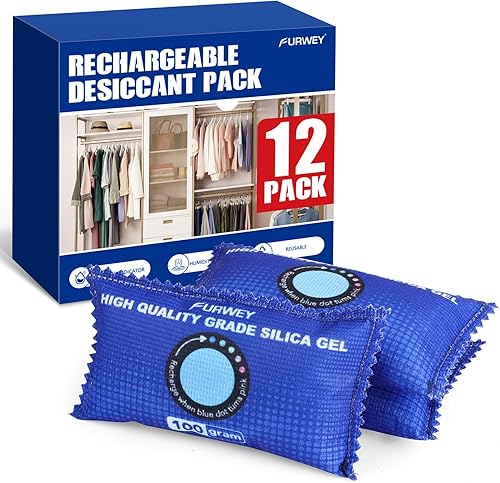
FURWEY Rechargeable Desiccant Packs 100 g (12 pack)
Best for closets and storage
- 12 × 100 g
- Rechargeable
Our verdict, pros and cons
Rechargeable 100 g desiccant packs with color indicator.
- + Reusable
- – Need recharging
Quick comparison
| Product | Type | Tank | Units | Score | Buy |
|---|---|---|---|---|---|
| ⭐ Our top pick DampRid Hanging (3) | Hanging bag | — | 3 | 9.0 | Check price |
| SANVINDER mini | Mini (Peltier) | 25 oz | — | 8.3 | Check price |
| Eva-Dry E-333 | Renewable silica | — | — | 8.6 | Check price |
| Arm & Hammer Hanging | Hanging bag | — | 3 | 8.5 | Check price |
| DampRid Hanging (6) | Hanging bag | — | 6 | 8.8 | Check price |
| FURWEY 100 g ×12 | Silica gel | — | — | 8.5 | Check price |
How to pick the right one for your closet
1. Electric, rechargeable or disposable?
- Mini electric (thermoelectric): pulls water nonstop, no refills, uses about as much power as an old light bulb. Best for walk-ins and very damp closets. Needs an outlet.
- Hanging absorber bags: hang them on the rod and forget them until the pouch is full. The easiest option for a regular closet.
- Cordless rechargeable: silica beads absorb moisture for weeks; when the indicator changes color, plug it in overnight to dry it out. Ideal for closets, gun safes and cabinets.
- Charcoal and cedar: better at odors and moths than at moisture. Use them as a complement.
2. Match it to the closet size
| Closet | What to use |
|---|---|
| Linen or coat closet | 1–2 hanging bags or one cordless rechargeable unit |
| Reach-in bedroom closet | 2–3 hanging bags |
| Walk-in closet | Mini electric dehumidifier + 1–2 bags in the corners |
| Drawers and shoe boxes | Silica gel packets or charcoal bags |
3. Where to put it
Damp air settles low and in corners against exterior walls. Put an electric unit on the closet floor with a few inches of clearance, and hang bags among the clothes, not pressed against the wall.
5 free tricks that multiply the effect
- Open the closet for 10 minutes a day while you air out the bedroom.
- If the closet is on an exterior wall, leave an inch of space between clothes and the wall.
- Leave a finger's width between hangers so air can circulate.
- Swap the solid door for a louvered one, or leave it cracked at night.
- Put a hygrometer inside: if it reads above 60%, take action.
If the whole bedroom feels damp, the closet is only the symptom: read how to reduce humidity in a room. For larger amounts of absorbers, compare our best moisture absorbers and reusable silica gel packs, or browse the whole moisture absorbers category.
Frequently asked questions
What is the best way to dehumidify a closet?
For a regular reach-in closet, two or three hanging moisture absorber bags are usually enough and need no outlet. For a large walk-in closet, a closet on an exterior wall or one that already has mildew, a mini electric dehumidifier works better because it pulls water continuously.
How often should I replace closet moisture absorbers?
Hanging bags usually last 30 to 60 days, depending on how humid it is. Replace them when the bottom pouch is full of liquid. In humid Southern summers they fill faster than in a dry Western winter.
What humidity should a closet be?
Between 40% and 55%. Above 60% the risk of mildew and that stale closet smell goes up quickly. A small hygrometer placed on a shelf tells you exactly where you stand.
Can I put a regular dehumidifier in a closet?
A full-size compressor unit makes little sense in a closet: it is bulky, loud and gives off heat. Use a mini thermoelectric unit inside the closet, or run a regular dehumidifier in the bedroom and leave the closet door cracked open.
Are moisture absorbers safe around kids and pets?
The liquid that collects is a calcium chloride brine that irritates skin and eyes and should not be swallowed. Hang them out of reach, keep them upright and dispose of the liquid down the drain with plenty of water.
📚 Sources and references
Official agencies for more information on humidity, mold and indoor air quality.
- A Brief Guide to Mold, Moisture, and Your Home — U.S. Environmental Protection Agency (EPA)
- Mold — U.S. Environmental Protection Agency (EPA)
- WHO guidelines for indoor air quality: dampness and mould — World Health Organization (WHO)
- Dehumidifiers — ENERGY STAR