🛈 If you buy through our links, Amazon pays us a small commission at no extra cost to you. That is how we fund these guides. How we choose.
📑 Table of contents
A dehumidifier in the bedroom is only useful if you can sleep next to it. The problem: compressors hum, fans whoosh and some units click on and off all night. These are the quietest dehumidifiers on Amazon.com, from near-silent minis to big units that stay surprisingly calm, plus the tricks that make any model quieter.
⚡ Quick summary: our top picks
Stock checkedThe quietest dehumidifiers
Ordered from quietest to most capable. All have auto shut-off and are in stock on Amazon.com.

SANVINDER 25 oz Mini Dehumidifier
Best for closets and small bedrooms
- 25 oz tank
- Ultra quiet
- Auto-off when full
Our verdict, pros and cons
A tiny, ultra-quiet thermoelectric dehumidifier for closets, RVs and small bedrooms.
- + Very quiet
- + Low energy use
- – Small capacity
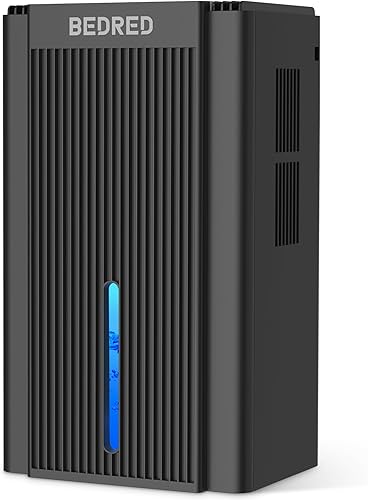
BEDRED 95 oz Dehumidifier for Home
Best for bedrooms and bathrooms
- 95 oz tank
- Auto shut-off
- Sleep mode
- Compact size
Our verdict, pros and cons
A compact best seller with a 95 oz tank, auto shut-off and a quiet sleep mode.
- + Quiet
- + Affordable
- – Not for basements

ToLife Dehumidifier with 95 oz Tank and Sleep Mode
Best for small apartments
- 95 oz tank
- Sleep mode
- Auto shut-off
Our verdict, pros and cons
Compact dehumidifier with a 95 oz tank, sleep mode and auto shut-off.
- + Easy to use
- + Quiet at night
- – Limited capacity

AEOCKY 50-Pint Ultra-Quiet Dehumidifier with Drain Hose
Best for quiet whole-floor drying
- 50 pints/day
- Up to 3,500 sq ft
- Drain hose included
- Around 40 dB
Our verdict, pros and cons
A 50-pint compressor model rated around 40 dB, with a drain hose for continuous operation.
- + Quiet for its capacity
- + Hands-free draining
- – Less known brand

Eva-Dry E-333 Renewable Wireless Mini Dehumidifier
Best for closets, safes and cabinets
- No cord while in use
- Color indicator
- Recharges overnight
- Lasts years
Our verdict, pros and cons
A cordless silica-gel dehumidifier: when the indicator turns pink, plug it in overnight to recharge. A classic with tens of thousands of reviews.
- + Reusable
- + Silent
- – Small capacity

DampRid Fragrance Free Hanging Moisture Absorber (3 pack)
Best for closets: the best seller
- 3 hanging bags
- Fragrance free
- No electricity
Our verdict, pros and cons
America's best-known moisture absorber: hang it in the closet and it traps water in the bottom pouch.
- + Very effective in closets
- + Zero maintenance
- – Disposable
Quick comparison
| Product | Type | Tank | Capacity | Score | Buy |
|---|---|---|---|---|---|
| ⭐ Our top pick SANVINDER mini | Mini (Peltier) | 25 oz | — | 8.3 | Check price |
| BEDRED 95 oz | Compact | 95 oz | — | 8.4 | Check price |
| ToLife 95 oz | Compact | 95 oz | — | 8.3 | Check price |
| AEOCKY 50 Pint | Compressor | — | 50 pints/day | 8.7 | Check price |
| Eva-Dry E-333 | Renewable silica | — | — | 8.6 | Check price |
| DampRid Hanging (3) | Hanging bag | — | — | 9.0 | Check price |
What decibels really mean
| Level | Sounds like | Good for sleeping? |
|---|---|---|
| 25–30 dB | Whisper, rustling leaves | Yes, even for light sleepers |
| 30–40 dB | Quiet library, soft refrigerator hum | Yes for most people |
| 40–45 dB | Refrigerator, quiet office | Fine as background noise |
| 45–52 dB | Moderate rainfall, quiet conversation | Better to run before bed |
Remember that decibels are logarithmic: every 10 dB extra sounds roughly twice as loud. And manufacturers usually quote the lowest fan setting, so treat specs as best case.
Quiet vs. power: the trade-off
The quietest units are also the weakest. A mini thermoelectric unit removes a few ounces of water per day; a compressor unit removes pints. If your bedroom has wet windows every morning or visible mold, a mini will not fix it no matter how quiet it is. The smart compromise: run a stronger unit in the evening with the door closed, then switch to sleep mode or turn it off when you go to bed. More on sizing in the best dehumidifier for a bedroom.
What makes a dehumidifier quiet
- No compressor: thermoelectric and desiccant units avoid the main noise source.
- Sleep or night mode: lower fan speed and dimmed display.
- Smooth cycling: a good humidistat avoids constant on-off clicks.
- Solid build: a heavier cabinet vibrates less.
The quiet option for each room
| Room | Quietest effective choice |
|---|---|
| Nursery or small bedroom | Thermoelectric mini with auto shut-off |
| Master bedroom with wet windows | Compact unit on sleep mode, or a compressor unit run before bed |
| Home office | Compact unit on low fan |
| Closet or gun safe | Cordless rechargeable unit: zero noise |
| Basement below a bedroom | 50-pint unit on a rubber mat, away from the ceiling joists under the bed |
Sleep better in a dry bedroom
- Run the dehumidifier for 2–3 hours before bed with the door closed.
- Air out the room in the morning for 10 minutes.
- Do not dry laundry in the bedroom.
- Check results with a hygrometer: aim for 40–50%.
More solutions in how to reduce humidity in a room, and the full ranking in our best dehumidifiers guide.
Frequently asked questions
What is the quietest type of dehumidifier?
Thermoelectric (Peltier) units are the quietest electric dehumidifiers because they have no compressor, only a small fan. Cordless silica units and moisture absorbers are completely silent, but they remove much less water.
How many decibels is a quiet dehumidifier?
Under 35 dB is whisper quiet, like a library. Compact units usually run around 30–40 dB. Compressor units typically land between 40 and 52 dB; around 40 dB is considered very quiet for a 50-pint machine.
Why is my dehumidifier so loud?
The usual causes are a dirty filter, the unit sitting on an uneven or hollow floor, a fan set to high, or the compressor clicking on and off. Clean the filter, put it on a firm level surface or a rubber mat and use the low fan setting at night.
Can I run a dehumidifier in a baby’s nursery?
Yes, if the room is genuinely humid. Choose a quiet unit with auto shut-off and no bright lights, keep it out of reach, and aim for 40–50% humidity. Avoid drying the room too much.
📚 Sources and references
Official agencies for more information on humidity, mold and indoor air quality.
- A Brief Guide to Mold, Moisture, and Your Home — U.S. Environmental Protection Agency (EPA)
- Mold — U.S. Environmental Protection Agency (EPA)
- WHO guidelines for indoor air quality: dampness and mould — World Health Organization (WHO)
- Dehumidifiers — ENERGY STAR